The wrong post – I made myself write
September 27, 2010 § 4 Comments

Ok, I admit it, this one is a force. A bit of sheer will applied to the keyboard. It’s been almost a month since my last post and that’s just not how long I want to go between posts so I’m giving myself a guilt trip.
Or maybe it’s an ego trip.
You see I have this thing. I like to feel clever – it feels good to write a post where you feel you shared a great idea or pointed out some cool observation. I try not to be smarmy about it… or falsely modest either: I believe that on my good days I’ve got something worthwhile to say, don’t we all? But that’s the trap isn’t it? That sneaky bit of self-indulgence wrapped up in the word worthwhile, that’s what gives me these frustrated moments sitting and staring at the screen, trying to come up with something that’s blog-worthy. Yeah, really, “blog-worthy” – like that’s even a thing. Yecch.
Usually this is where the browser opens up and I let the web distract me away into oblivion – excusing myself for not writing with a shrugging “at least I tried.” But really, I gave up – I let the words get too hard, put too much pressure on them, got caught up in importance and meaning. I lost touch with the idea that these words can be playthings. Oh just give me a limerick! A bit of badinage, a freeform stream-of-conscious romp through alleys of artful, alliteration. Give me a stumper – any old excuse to run to the dictionary. Give me a crossword, an acrostic, challenge me to Scrabble! Those are words having fun!
So why do all the cool, fun, tongue-in-cheeky bits of language evaporate into thin air when it’s time to write the blog? Are they sucked into the cooling fan of the computer? Are they secretly meeting behind my desk plotting to dangle a participle? These words that could be here doing their job, are they experimenting with some exotic punctuation? “…but Dad all the cool vowels are getting umlauts this year…” Are they in the closet trying on fonts to see which ones make their ligatures look fat? Why do the words abandon me just when I need them most?
Because they’re hanging out with all my ideas.
Seriously, it’s past curfew – time for at least one idea to come home and shout “I’m here!” and then eagerly pop out on the screen and say “I’m sorry I kept you waiting, let’s get to work now.” It doesn’t even need to be a good idea. Rejoice! The prodigal idea returneth!
But I guess it’s just going to be one of those nights where the ideas stay out until dawn drinking with their no-good buddies, the concepts. No doubt, tomorrow I’ll think of a bunch of great posts. Posts ideas that are really worth your time, filled with sage advice and clever quotable passages. Inspired concepts for life changing posts that could solve the energy crisis and bring species back from the brink of extinction. But I’ll probably forget to jot those down.
So for tonight all I’ve got to say is that I stepped up to bat and took a swing. I saw it through. I checked in. I did the writing. 583 words to say I was here. I think tonight that will just have to be enough.
Veni, Vidi, Scripsi.
(I came, I saw, I wrote)
Harry told me, Work is Personal
September 2, 2010 § 4 Comments

Have you ever been in a bookstore and just felt drawn to a book like a magnet? Yesterday, I had just finished a meeting in a bookstore coffee shop, so before heading back to the car I thought I would do a little title scanning – one of my favorite hobbies. As I patrolled the aisles I came upon the clearance shelf and there, staring back at me, with an inviting, “come hither”, $4.98 markdown price tag on the cover was Harry Beckwith’s “The Invisible Touch – The Four Keys to Modern Marketing.” I figured that’s a buck for each key and 98 cents for the experience: How could I resist?
Like I said, this was yesterday, so I’ve really only just cracked the cover, but I’ve already stumbled on this little gem: “Work is personal.” That’s it, three words, but when I read that I just thought “wow!” which I think mirrored the author’s reaction when he first encountered those words as a slogan on the back of a Fast Company baseball cap.
“Work is personal” – it’s kind of juicy, but I’m not going to try to outdo Harry breaking this idea down, because he just nailed it, I just felt compelled to share his words though:
“Work is not about business; it’s about us. The human dimension of business — the messy, emotional, utterly human dimension — is not merely important; it is all encompassing. As a result we must plunge into the world of feelings — truly frightening territory.”
I just love that! I think it nails a lot about why I do what I do, and I think it is so important that as a business author he acknowledges that this is not an easy nor comfortable place for the business-minded to dwell. Every day it seems the amount of evidence and literature mounts up supporting the idea that success in business is not so separate from our human qualities – just read a few Dans like Dan Pink, Dan Roam, Dan Ariely or Dan Goleman and you’ll get a taste of a rising tide of interest in the inescapably human aspects of business. We may wrap ourselves in corporate veils, but beneath that cloak we are people: frail, humble, shy, bold, altruistic, greedy, brilliant, bullheaded, savvy and irrational people. We want meaning, we want fulfillment, we want marvelous experiences – I believe that a business can provide all of those and I think you can build one of those businesses if you keep the human experience in mind for your customers, employees, vendors, and yes, for you too.
Thank you Harry for reminding us that Work is Personal – and if that’s the kind of insight that’s in the intro, I can’t wait to read the rest of your book. I’ve already gotten great returns on my $4.98 investment.
What’s the best book you’ve read lately? Got a “Wow!” to share?
When the wiring goes wrong – a cat’s tale.
August 24, 2010 § Leave a comment
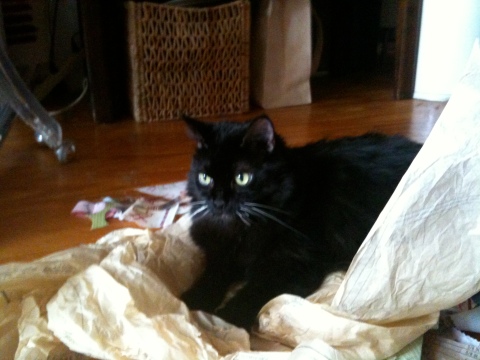
She’s intense, willful, dangerously stealthy, surprisingly clumsy, endearing, ponderous, and difficult to ignore. She’s Ally the cat – one of two that share our home. Ally is sweet and cuddly and a contender for most annoying cat of the year. But it is only because she’s nuts. Something’s wrong in her wiring. Some primordial instinct in that little feline brain gets mixed up causing her to attack her own tail. It’s probably some play-as-hunting-practice algorithm that’s gotten a bug in it. She sits, gets bored, starts swishing, then thumping her tail and then it’s swat, thump, swat, thump, swat, growl, swat, swat, bite! And then she squeals gets up and runs away from her attacker. The whole thing would be comical if it wasn’t so darn frequent – or frequently happening so darn close to my bare feet. My bare feet have this funny allergy you see to needle-sharp teeth and all manner of slashing, swiping claws. As an aside I hope that the thought of me, bare-of-foot doesn’t put you off this blog post, frankly I do some of my best writing without shoes, but my hobbit-like writing practices are not the point here. The point here isn’t even that my cat is nuts, which she is. The point is she’s stuck in a bad pattern that may have been good, useful or productive once, but isn’t anymore. Ally is saddled with these weird, stress-inducing behaviors that certainly were important survival skills for her innumerable cat ancestors. But the thing is she doesn’t know that, she’s not intending to make me scream when she misses her tail and tags my big toe instead – she’s just doing what she’s wired to do.
I don’t think cats are the only ones who do this. A company will sometimes try to operate with patterns and processes that may have been successful in the past, but haven’t adapted to changing market conditions or new technologies. “Yell and Sell” marketing tactics end up doing more to turn off buyers when once they stood as the pillars of brand awareness. A person who hasn’t job hunted in 15 years is laid-off and suddenly thrust into a world that has been forever changed by Monster, Career Builder and LinkedIn. Over-dependence on old habits of looking in the paper for listings and sending unsolicited resumes to large companies have distracted that job seeker from building new skills and a vibrant network through social media just when they need every advantage. These people and companies aren’t intending to flounder, but they may have gotten stuck in old patterns that used to be the right answers. It’s a tough trap because they feel like they are doing the right things, but they are no longer getting the old results and they often find it hard to see the problem themselves.
A cat’s gotta eat, but lightning fast reflexes and hair-trigger aggression don’t make a bit of difference when your prey is a tin of Sophist-a-Cat Supreme. The felines of the Cohen kitchen, our domestic savannah, have to rely on a whole new set of emotional and psychological skills (primarily based on cuteness) to get the big human with the fancy thumbs to open their cans for them. Believe me, if cats could work the pop-tops we’d live in a very different society. So here’s the question: Are you trying to hunt for your supper when you could be going to a supermarket? What habits are you hanging onto that are no longer getting you results? What processes and approaches should you change to acknowledge today’s market realities?
Or the question I ask Ally: Have you got a tiger by the tail or has the tiger gotten you?
Endearing imperfections
August 2, 2010 § 2 Comments

The world is not a perfect place – a quick glance at any newspaper, newsfeed, news site, or newscast will provide ample confirmation for that idea, but so what? Where else are you going to live?
The world is not perfect, and neither is your spouse, sibling, parent, friend, child, or pet, but we love them, warts and all, right? I mean my dad sneezes so loud it shakes the windows, my cat refuses to use a scratching post in any room that has a sofa, and I’ve learned the hard way that when my girlfriend asks for a tiny bite of my sandwich she really means something in the range of tiny-for-a-shark-sized bite to just-go-ahead-and-make-a-new-sandwich-sized bite – but do I love them any less? Of course not, in fact sometimes it’s the foibles, the goofiness, the vulnerabilities, the endearing little imperfections that are well, endearing (except the sandwich thing that’s just annoying).
So why are we trying so hard to be perfect online? Why do we have this impulse to sanitize our communication and project some glistening fantasy of personal brand image for the world to embrace? Vanity? Insecurity? Fear of rejection? Well I say vanity-shmanity just be yourself.
In a photoshopped world filled with spin doctors and corporate speak more and more people are seeking authentic, plain as folk, communications. Letting down your hair, lowering your guard and risking letting a little bit of the real you out into the light of day can be a healthy thing for you and your personal brand. It’s a lot more sustainable and reliable for you to just be you than to always try to live up to the glistening fantasy you. Instead of doing cartwheels to try to project a flawless facade, focus on what you got that rocks – that stuff you do with world-beating zeal and samurai skill. Put the attention on those things and the warts become a whole lot less important. I mean if you think about it, someone with zealously applied samurai skill can be intimidating, but if they’ve got a well placed wart too that might be just enough to make them seem approachable.
Focus on your strengths and don’t get bent out of shape about your flaws – they might just be the endearing qualities that help you build an authentic personal brand.
Love, brands and forgiveness
June 13, 2010 § Leave a comment

Doubtless there are tons of marketers spending heaps of time, money and resources toward trying to make their brands lovable. Sadly, many of these efforts fall far short of that lofty goal and at best achieve a temporary state of likability.
Cool features, great packaging, witty ads, attractive pricing are all dutifully studied, discussed, reviewed and presented and are all too often cast aside when a new ad, a better price, a shinier package, one extra feature or yikes! – one misstep comes along. Loyalty, or rather its lapse, tells us if we are liked, but not loved.
Perhaps the thing to put the attention on and the energy behind is not to strive so systematically to be lovable, but instead to figure out if your brand might be forgivable.
What does it mean to be forgivable? When we forgive we are letting go of resentment that we feel when someone has offended or hurt us. We look past the infraction, the shortcoming, the fumble and refocus on something else, something that forms the basis of the relationship, something that we deem worthy of forgiveness, something that merits a second chance. Is it love? Maybe not always, but it is certainly a step in that direction. When a company can give us something to believe in and then consistently acts in accordance with that belief – demonstrates the belief not just in words, but in choices and actions, then it is developing for those aligned with that belief something that for want of a better word I would call forgivability.
If I can forgive a brand for a mistake, even an offense, then it is likely that I am drawn to some ideal, a value, belief or empathy with that brand. Certainly some offenses are too severe to be forgiven, but I think that more often forgiveness is simply a moot point, because despite the efforts towards being lovable there is no relationship established, no buy-in to anything meaningful beyond the veneer of product, package and price.
If your company should stumble, release a clinker of a product, have a little scandal, make a PR gaff, who would forgive your brand? Who amongst your customers would give you a second chance? Learn who they are and why they would deem you worthy of a second shot and you may find yourself staring at a mirror’s reflection of your core brand values – or perhaps a compass for finding a true and sustainable path to your customer’s hearts.
So say what you’re trying to say.
June 9, 2010 § Leave a comment
Do you ever get word-stuck? Tongue-tied at the keyboard as it were? You know, those moments when you want to get the words out, but you’re tangled, you can’t start it right, it just won’t flow? Here’s an idea: say what you’re trying to say.
But you protest – “I am trying to say it.” No, I mean actually say it – out loud. I learned this from one of my best resources, my dad. Besides being the Cohen family business sage, Scrabble champion, pun-meister and Thanksgiving turkey carver, he also has often worn the hat of writing coach and editor for all his progeny. Many was the time that me and my sisters would be stuck on a school paper or later, a business brief or some such, and invariably he would invoke that simple little nugget “So… say what you’re trying to say” and it always worked.
Saying (out loud) what you’re struggling to say (in written form) somehow seems to take the pressure off. It engages another part of the brain, obstacles slide away and you’re able to just let the words flow – maybe not smoothly, maybe not in a grammatically sound way, but the raw meat of meaning will be there. From there the rest of the writing job is cleanup and polish. Saying it gets the idea out in the open – no longer hidden behind a tangle of pressure stemming from deadlines, or uncertainty, perceived importance or even vocabulary.
So next time you’re writing, or rather, not writing because you just can’t get the thought out through the pen or the computer, try another path. Get a friend and tell her to ask you what you’re trying to say. Call your own phone, ask “What am I trying to say?” and leave yourself a message so you can transcribe it later. Turn on the mic on that laptop of yours and just blurt away. The point is set aside the style and the structure, get them temporarily out of the path of the idea so you can get that idea out into the world. Birth it, or maybe burp it, just get it out rough and raw. You can then shape it. Make it better, clearer, more focused now that it is out – which by the way is something else my dad is great at, but don’t call him, I keep him busy enough as is ;)
Safety Last: Mission Statements that Motivate
May 19, 2010 § Leave a comment

It’s a business cliche – the benign, committee-composed, sanitized, safe, yawn-fest of a mission statement that seems to propagate across so many organizations. It usually goes something like this: “Our mission is to be the respected leader in our industry by serving our customers with integrity and best-in-class service.” Huh? Okay, it is safe, but If your mission statement sounds like it could have popped out of a random mission statement generator then you’ve missed the point, and an important opportunity.
If there is no actual mission in the mission statement then it isn’t really important, is it? It isn’t going to magically motivate anyone or clarify any employee’s judgment when faced with a decision. How does “dedication to serving excellence” help any CEO map out strategy? What kind of compass is “aspiring to world-class performance” when you’re trying to set direction for a company culture and brand?
Hit the dictionary and you’ll come up with mission = “a specific task with which a person or a group is charged”. Now that sounds simple enough. It doesn’t mention safety. It doesn’t mention committee-think or not offending anybody. It does say specific – I like that.
So rather than harp on about how to write a mission statement I’m just going to offer up a few I’d love to encounter in the wild:
1) Our mission is to take our clients’ businesses from $1 million in revenue to $10 million in revenue – then introduce them to people who can take them further.
2) We are dedicated to cleaning up other people’s ecological messes in a profitable way without dumping our garbage in anyone else’s lawn.
3) Our company’s purpose is to build lawnmowers that make you want to mow the neighbor’s lawn too.
4) Our mission is to get customers from point A to point B, efficiently and safely, without ever forgetting they are people, not freight.
5) We are here to lovingly build furniture that your great-grandchildren will fight over.
6) Our mission is to brighten the world with lights that use less energy.
7) Our mission used to be to make household products that make life better for homemakers, now that we’re big we’ve amended that to also make life better for our employees, our communities and our planet.
8) We were put on this earth to design shoes that make you feel sexy.
9) Writing elegant software that makes your job more fun is our mission.
10) Our mission is to make beautiful kites so that more people look up at the sky and smile.
Got a mission statement that doesn’t play it safe?
What’s the most specific, riskiest, or useful mission statement you’ve encountered?
Talk, Talk, Talk, Draw, Draw, Draw
May 16, 2010 § 2 Comments

Wow, it feels like I just started podcasting and I’m already up to episode number, now wait a second, let me get my calculator, tap… tap.. tap.., carry the one, oh yeah there it is – episode three! I know, big milestone right? But it is a big transition to go from “I’m thinking about starting a podcast” to actually have guests planned in advance – it’s exciting too! Especially when you’ve got some interesting guests on deck – and I do ;)
Tomorrow is going to be cool Julie Stuart will be joining me for episode 3 – Julie has a very cool and unique job: she is a visual facilitator, in other words she makes ideas visible. Combine the skills of a meeting facilitator, an illustrator and a mind-mapper – mix them all up with a big smile and you’re getting into Julie’s territory. When I first stumbled across her website I was wowed – I had never heard of anyone doing a job like that before! It takes talent to draw, to move ideas into images, and a lot of people with that talent would run screaming from the room if you asked them to draw while standing in the middle of a room full of people – not to mention a room full of high-powered executives. Julie’s created a brand for herself that is not only unique, but highly effective – she’s notched clients like the CDC, GE Energy, ConAgra and the National Wildlife Federation. You better believe I’m going to ask how she’s taken her talents and woven them into such an effective brand story. You don’t want to miss this one!
For those of you not familiar with Blog Talk Radio, the show is presented live and you can call in with questions. Shortly after the show is done the recording is available to download or stream at your convenience. My show is live Mondays at 10:30am EST http://www.blogtalkradio.com/david-cohen and the Call-in Number if you want to ask a question is (347) 989-8132. I hope you’ll chime in!
Finding empathy in the dark
May 4, 2010 § 2 Comments

Marsha, Thank you for inviting me to tour Dialog in the Dark – it was an extraordinary exhibition and an extraordinary experience. As a visual artist the thought of living without sight is frankly terrifying and it was with no small amount of apprehension that I embarked on the tour, but I am so glad that I have experienced this. To be adrift in the dark was not how I imagined it, the presence of the other members of my group were reassuring and our steadfast guide, Erik, was a true comfort. A beacon in the dark, his voice was our guide and no light was necessary for him to steer us away from danger and into a new appreciation of the palette of our senses and a new gratitude for the one sense that we temporarily set aside for that short time. We were tourists in his world, safe in knowing that ours was just a door and a curtain away, but enriched to have stumbled together in the dark. I hope anyone who might read this will go take part in this moving experience and learn that we don’t need our eyes to see each others’ humanity.
-David
 David S. Cohen - Left Brain, Right Brain
It’s moving time!
October 18, 2010 § Leave a comment
Let's get movin'
Well folks, I’m making a move – a virtual one. You see I’ve just recently launched a major rebranding/rebuild of my website and I’m going to be doing my blogging there instead of here.
This is my last post here at this address. In a month or two I’ll set a redirect to automatically reroute you to the new blog, but for now I didn’t want to confuse anyone.
The new blog is located at http://equationarts.com/blog, but don’t worry, all the old posts and drawings are waiting for you there along with a whole lot more. I’ve put up more galleries for doodles of Space Bunnies and such, a better page for keeping track of my podcast, The Be a Beacon Show – Personal Branding with David Cohen, and something new, an ecard service, which I’m calling doodlegrams.
I hope you’ll continue to visit the blog in it’s new home, and if you do please drop me a note to let me know what you think of the new site.
Thanks!
David